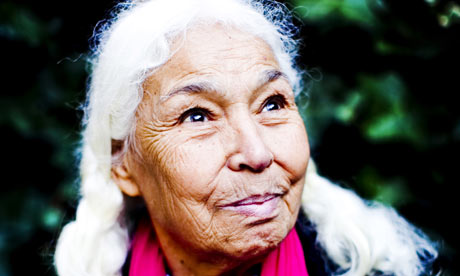
I am becoming more radical with age," says Nawal El Saadawi, laughing. "I have noticed that writers, when they are old, become milder. But for me it is the opposite. Age makes me more angry."
from the guardian
I am becoming more radical with age," says Nawal El Saadawi, laughing. "I have noticed that writers, when they are old, become milder. But for me it is the opposite. Age makes me more angry."


Minh-Ha T. Pham, based in New York City and San Francisco, shops sample sales with a keen and discerning eye. She writes about the ways in which national publics and polities are organized around traditional and new media that are increasingly shaped and limited by neoliberal discourses and policies. Focusing on the fashion media and the Vietnamese American media, both her projects are concerned with the complex and contradictory relations of communication technologies, consumerism, and capitalism.
Mimi Thi Nguyen, based outside of Chicago, scours thrift and vintage stores with reckless abandon. Situating her scholarly work within transnational feminist cultural studies, she writes about neoliberalism and humanitarianism, war and empire. A former zinester, Punk Planet columnist and Maximumrocknroll shitworker, she has also published on punk and queer subcultures.
How is women's subordination as women connected to related oppressions based on race, ethnicity, nationality, class and sexuality?
One of the reasons I wasn't super involved in riot grrl after it started (other than through Bikini Kill/ and making zines) was because I thought it was too universalizing and too focused on this supposed common identity of "being a girl" and that that somehow makes us all victims....this is hard to generalize about, but I had read Inessential Woman by Elizabeth Spelman and Gender Trouble by Judith Butler as well as Feminist Theory From Margin to Center & Ain't I a Woman by bell hooks and Women, Race and Class & Women, Culture and Politics by Angela Davis and This Bridge Called My Back and other feminist anthologies by women of color...I saw that a lot of the same problems with the second-wave were reappearing in riot grrl. But because Bikini Kill and riot grrl were under constant attack, it was hard to voice my critique. A lot of girls were coming to terms with their own sexual abuse, experiencing sexual assault and/or coming out as queer. Additionally, people were attacking us at shows and accusing us of being sexist for excluding men and we were constantly being sexually harassed, so it was not exactly a good time to be critical. The group of women who I know that were involved in riot grrl were very much in need of support and could not handle criticism.
In my own work, back then, I wrote about "being inclusive" and was vaguely calling for solidarity, but made no real, sustained attempt at making that happen. Looking back, I think my idea was that if all girls started bands and created their own media, then everyone would be represented and we'd figure it out eventually. Well...that was a little naive and Utopian....to say the least! What I learned from this, is that, because not everyone has equal access to resources and leisure time, dominant hierarchies will reproduce themselves in the underground as well as the mainstream. This is why I think the Girls Rock Camps are cool, they are actually getting girls access to skills and resources and not just telling them to "start a band", but actually really facilitating the whole process and creating an inclusive, participatory forum where girls define themselves on their own terms and have a voice.
Also, when I was younger I was really into my own scene at the expense of having a very good understanding of how things worked outside of my own personal experience. While "the personal is political" is a good slogan, in reality, when privileged people focus on personal politics and giving voice to their experience, the result is a limited, privileged version of the world. In other words, advocating for people to 'represent themselves' is not always the best strategy. White people need to address racism and be accountable, just as men need to address sexism and be accountable for how it manifests itself in their work. So live and learn I guess.
I also think it's important to remember the girls of color who were involved in riot grrl/90's punk rock feminism, such as Amy, Emily and Wendy from Emily's Sassy Lime, Mimi Nguyen from Evolution of a Race Riot (who you already mentioned), Sabrina Margarita from Bamboo Girl, Dasha Bikceem from Gunk, Phyllis Forbes from Raooul/The Tourettes, Akiko Carver, Cindy Hales... to name a few off the top of my head. I realize these are just names and maybe not that helpful, but I think it's important not to generalize that riot grrl was "white, straight, middle class"' bla bla bla, when there were a lot of queer girls involved and definitely some working class/poor girls and/or girls of color there from the beginning.