Showing posts with label Feminism in Egypt. Show all posts

Sunday, June 20, 2010

Vijay Prashad & Inji Aflatun


Anti-colonial nationalism, even in its reformist incarnations, worried about the woman question. An end to social oppression found its way on to the agenda of national liberation. At its most traditional, such an end looked like the modernization of patriarchy, with the new woman relegated to the domain of the home. On the more progressive side of national liberation, one finds many who argued that cultural traditions had ossified under the impact of patriarchy and feudal relations, and any opportunity to redress this had been suffocated by imperialism's alliance with the old social classes, which benefited from misogyny and status. Women and men, in this model, had to struggle against conservative domesticity and reconfigure what it is to be the public space of the nation and the private domain of the family.
-Vijay Prashad, The Darker Nations

The chapter "Cairo" in The Darker Nations by Vijay Prashad provides context to "We Egyptian Women" by Inji Aflatun in the Feminist Theory Reader.

Prashad views women's participation in anti-colonial struggles as a "first step towards liberation", claiming that "imperialism made progress for women nearly impossible". Women fought alongside men for national independence in Algeria, Cuba, Guinea, Indonesia, Kenya, Korea, Oman, Venezuela & Vietnam. Women dominated street protests in Egypt, India & Zanzibar, etc. This was a basis for anti-colonial solidarity all over the world. The struggle for representative democracy provided an ideological basis for extending political rights to women. This setting needs to be taken into account when reading 20th century feminist theory.

Putting Aflatun's essay in this context is helpful.

Egypt briefly granted women the vote in 1923, after independence was established. The Egyptian feminist movement can be traced back to this time period. Women won the vote again in 1956.

Writing in 1949, Aflatun equates democracy & modernization with women's full political participation. She claims the enemies of women are enemies of democracy, arguing that women are citizens and that to deny them rights would be an "injustice to society".

Rejecting the public/private split of classical liberalism, Aflatun does not see family (the domestic sphere) in opposition to society. She points out that women deal with social problems on a daily basis, naming clothing, food, health care, education, children and housing as issues.

She identifies British imperialism as contributing to illiteracy, noting that rates were highest before 1923. Education and literacy are goals to strive for, not barriers to granting women the vote.

Aflatun concludes by examining the status of women in an international human rights framework, noting that the UN Charter (1946) names equality as an issue and the UN Universal Declaration of Human Rights (1948) claims that everyone is deserving of the same rights, regardless of sex.

Because I still don't know that much about 20th century Egyptian political history, I am not sure why Aflatun's feminism hinges on the idea of Egypt as a modern state. Following Prashad, I think it's important to view this as part of the larger struggle for Third World independence, but it's unclear to me why Aflatun is so focused on viewing Egypt as a civilized nation. What do "modernization" and "civilized" mean in this context? In order to understand this, I think I need to know more about Nasser's Pan-Arabism.

Prashad notes that Nasser's Egypt has been criticized for promoting "state feminism", where women became dependent on the state instead of the family.

Aflatun's essay ends by praising Syria as the first Arab nation to give women the right to vote, but notes that this was limited progress because it was only given to educated women. It's not clear if Aflatun believes that all women are equal, but she does advocate full political participation for all women.

Thursday, April 15, 2010

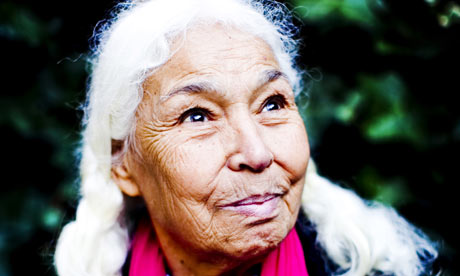
Nawal El Saadawi in the News


I am becoming more radical with age," says Nawal El Saadawi, laughing. "I have noticed that writers, when they are old, become milder. But for me it is the opposite. Age makes me more angry."


from the guardian

Tuesday, March 30, 2010

Women in Egypt by Angela Davis


Women in Egypt is a theoretically rich essay that documents a trip Angela Davis took to Egypt in the mid-80's. She made the journey intending to write about her experience, not realizing at first that the funding for her travel stipulated that she focus her writing about women on sex. At the time there was a crusade on the part of some influential western feminists to "save" third world women from the practice of Female Genital Mutilation (FGM). This campaign was culturally insensitive, condescending and ignorant to the point of overt racism and often went hand in hand with an imperialist agenda. Davis was aware of this dynamic and sensitive to this complexity, but got caught in the middle of some serious conflict nonetheless, which she navigates thoughtfully here in telling the story.

Women in Egypt does a great job of reflecting all the nuances of this situation, taking colonial "feminists" to task for imposing an agenda onto a setting they often understood little about. Davis carefully re-frames the issues, documenting feminist debate/disagreement among Egyptian women and examining her own position as an African-American citizen of the United States with a revolutionary agenda. Davis does not defend FGM, but she explores how Egyptian feminists talk about it and gives the reader a complicated picture.

This condescending style of "feminism" probably sounds somewhat familiar to you, even if you haven't read much post-colonial feminist theory because it's very similar to what happened after 9/11. Suddenly Laura Bush and Ms. Magazine were working together to "save" Afghan women from the Taliban as a justification for war!* Imperial aggression on behalf of feminism? Who is "saved" by bombs? Please read what what RAWA and other Afghan women have to say about this if you haven't already.

I first read Women in Egypt during the Gulf War in early '91. I remember quoting it in an essay I wrote that examined media representations of women and war--contrasting the "liberated" American female soldier marching off to war to "save" the "oppressed" Arab woman symbolized by the veil. This has become such a prevalent trope since 9/11 that its hypocrisy might not strike us with the full force that it deserves.

In the face of this absurd propaganda and imperialist nonsense western feminists need to become familiar with the history of feminism in the Middle East. Egypt has a rich feminist history and is a good place to start. Last night when I was reading We Egyptian Women by Inji Aflatun I was struck by how much I don't know, although I have read some stuff...I don't want to generalize about Aflatun's essay, because I really don't fully understand the context it was written in, so I'm going to spend a little bit of time with that this week and it may be awhile before I write about it here.

Anyhow, I don't want to be like, HEY!, this is Jigsaw's GUIDE to FEMINIST THEORY like I know it all and I'm the authority on everything. It's more like, I really think it's important to talk about this stuff and by using Jigsaw as a way to do this work publicly, hopefully I'm encouraging participation and starting a conversation. I did study transnational feminisms in school but really think this needs to happen outside of the classroom setting in order to have more of an impact.

Re-Reading Women in Egypt by Angela Davis last night, I realized this was the starting point for me. It was when it clicked in my head, right, ok...if I want to know about women in Egypt, then I need to research Egyptian feminism and learn how women define issues there, because their issues are not going to be the same as my issues, duh, and also, I need to be careful not to treat "women in Egypt" as a monolithic entity, but realize that among Egyptian feminists there is disagreement and conflict and class difference...rural/urban difference etc....and I also need to look at the history of the country in terms of colonialism and examine the culture and look at the history of U.S. foreign policy, political economy...and position myself as a U.S. citizen, white, college-educated etc. In a word, specificity.

So I want to take this opportunity to thank Angela Davis for this great essay and suggest that everyone read it if you haven't already. It was published in her book Women, Culture and Politics but it may have been re-published since then. Her writing is so good here. A lot of her later work is filled with academic jargon and some of her earlier stuff is as well, but this is clear, super readable and seems to be written for a popular, non-academic audience. Highly recommended!


To my readers: I'd be interested in hearing about feminist theory that had a similarly expansive impact on your thinking.

*For more writing on this, check out an essay by Amy Farrel and Patrice McDermott called Claiming Afghan Women: The Challenge of Human Rights Discourse for Transnational Feminism in Just Advocacy: Women's Human Rights, Transnational Feminisms and The Politics of Representation, edited by Wendy S. Hesford and Wendy Kozol...it's hard to read (academic language) but pretty good.

Monday, March 29, 2010

Inji Aflatun & Egyptian Feminism


Ok...up late reading "We Egyptian Women" by Inji Aflatun in the Feminist Theory Reader (FTR) instead of going to see Girl Trouble open for Blowfly or Joey Casio at the Red House.

So I'm sitting here concentrating on this short essay that argues for women's suffrage and full political participation and realize that the FTR is giving me no context whatsoever other than that it was written in 1949. This is the second entry after the intro. Not a good sign.

No history of Egypt, no economic analysis of colonialism, no discussion of Egypt in WW2 etc

So, I got out all these books and started re-reading "Women in Egypt" by Angela Davis in Women, Culture and Politics (which is just such a great essay by the way), looking for my Nawal El Sadaawi Reader (can't find it), skimming the chapter on Egypt in The Darker Nations by Vijay Prashad (so good), checking the index of Leila Ahmed's Women and Gender in Islam (I really need to read this whole book someday), glancing at Harem Years by Huda Shaarawi (which I forgot I even had)...then I come in and start googling "feminism in Egypt" and now it's really late and I am feeling invigorated yet overwhelmed by how much I don't know and how much I want to learn.

Well, this is my idea of fun, but I don't have too much to report just yet....other than that it seems like a gross oversight to start a feminist anthology with this essay without any kind of socio-economic or cultural/political context. Huh.